Want to know more about stems?
click the folder below
A work by group 1

External Parts

Internal Parts

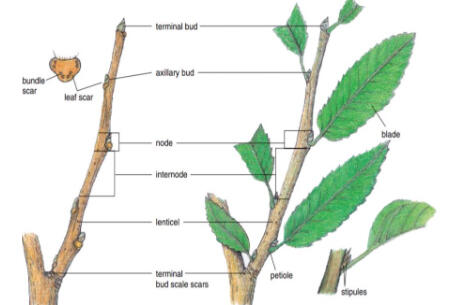
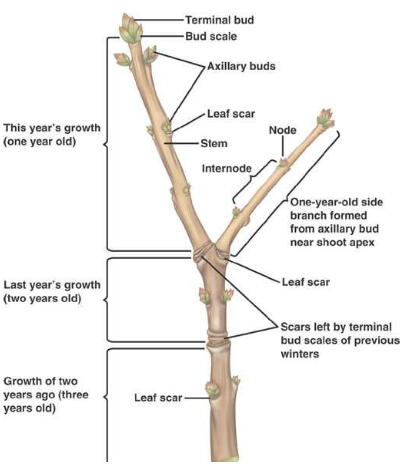
external parts
Nodes: area or region of a stem where a leaf or leaves are attached.
Internodes: stem region between nodes
Petiole: a stalk that serves as an attachment of the leaf to the twig Axil: the angle between a petiole and the stem
Axillary bud: bud located in the axil
Bud Scales: It protects the buds Terminal Bud: It is a little larger than the axillary bud; do not become separate branches
Stipules: paired, often somewhat leaflike, appendages that may remain throughout the life of the leaf
Lenticels: these are porous, raised spots on woody stems, roots, and some fruits (like apples, potatoes) that function as crucial pores for gas exchange.
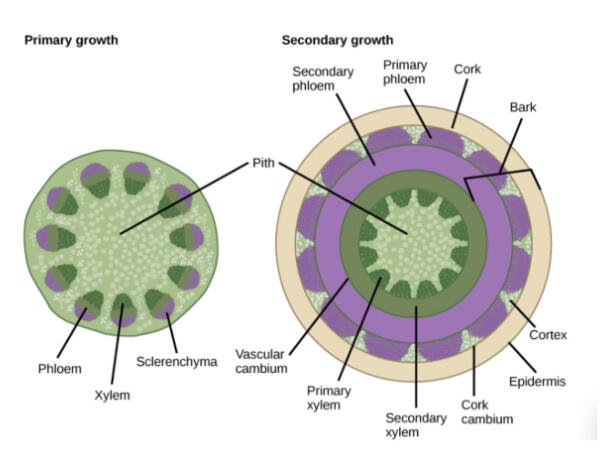
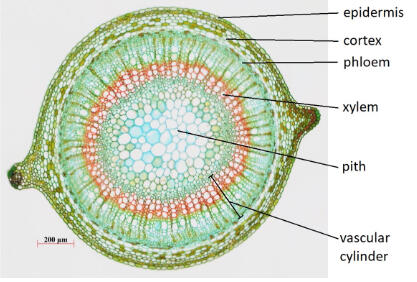
Internal parts
Pith: The central core, often for storage, which can be solid or hollow.
Cortex: It's mainly made of parenchyma cells, responsible for storing food and, providing support
Vascular cambium: is responsible for the secondary growth in plant stem, hypocotyl, and root tissues.
Cork cambium: woody species; arises within the cortex, produces box-like cork cells which are impregnated with suberin (waxy substance that makes the cell impervious to moisture
Epidermis: forms a protective outer layer on stems (and other parts), preventing water loss and infection
Xylem: Transports water and dissolved minerals from roots to stems and leaves
Phloem: Transports sugars (food), amino acids, and hormones from leaves to other plant parts

Monocot Stems

Dicot Stems


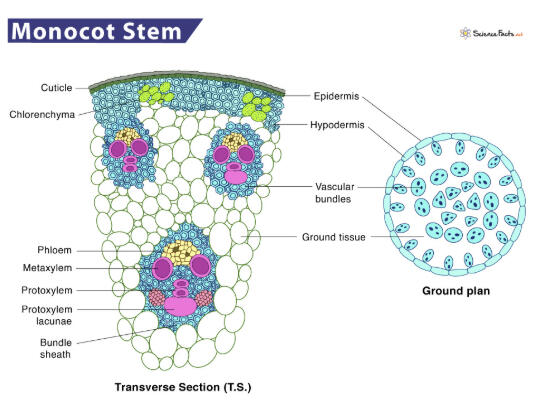
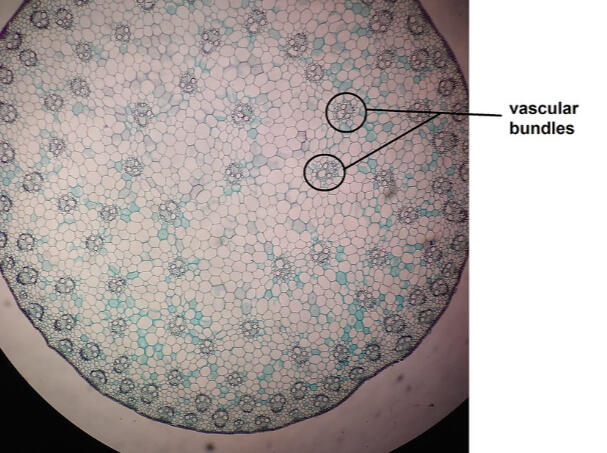
Monocot Stems (MONOCOTYLEDON STEMS)
These stems have usually large hollow vessels elements and no secondary growth.
They are characterized by scattered vascular bundles throughout the stem, while lacking of TRICHOMES, PERICYLE, , MEDULLARY RAYS, LESS DEVELOPED PITH/ CORTEX, stele and cambium.
In the monocot stems, the phloem are oriented towards outside of the plant, the xylem towards inside.
The vascular bundles are surrounded by a layer of parenchyma cells or called a bundle sheath and are arranged throughout the ground tissue in concentric circles.
Examples are rice, corn, wheat, sugarcane, bamboo
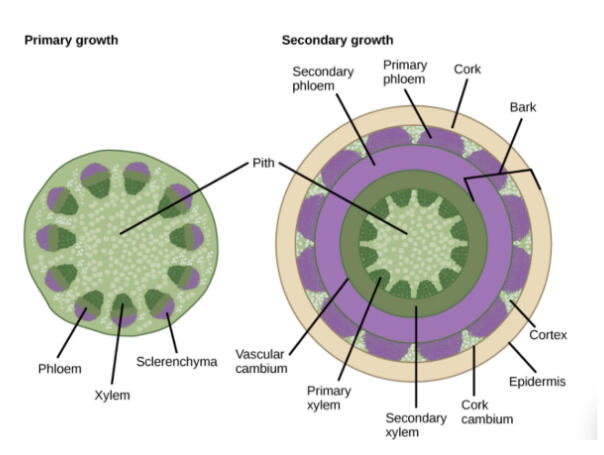
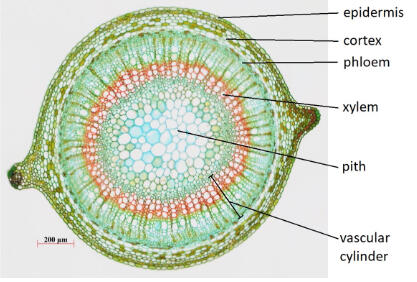
Dicot Stems (DICOTYLEDONOUS Stems)
Vascular bundles are arranged in a ring around the circle of the plant stem
The cortex is oriented outside while the pith inside.
The presence of pericycle, cambium, medullary rays and secondary growth and a well developed cortex and pith
Examples are bean, pea, mango, sunflower, rose
References
Admin. (2020, August 17). Monocot and dicot plants- anatomy. BYJUS. https://byjus.com/biology/monocot-dicot-plants-anatomy/
Admin. (2022, September 16). Primary structure of Dicot Stem. BYJUS. https://byjus.com/biology/primary-structure-of-dicot-stem/
Britannica Editors (2025, March 7). stem. Encyclopedia Britannica. https://www.britannica.com/science/stem-plant
Cactus Art. (n.d.). Stem succulent. In Cactus Art Dictionary of Succulent Plant Names. Retrieved December 20, 2025, from https://www.cactus-art.biz/note-book/Dictionary/DictionaryS/dictionarystem_succulent.htm
EBSCO. (n.d.). STEMs (Botany) | Research Starters. https://www.ebsco.com/research-starters/anatomy-and-physiology/stems-botany
Encyclopaedia Britannica. (2024, August 27). Bulb. In Encyclopaedia Britannica. https://www.britannica.com/science/bulb
Encyclopaedia Britannica. (2024, August 27). Corm. Encyclopaedia Britannica. https://www.britannica.com/science/corm
Encyclopaedia Britannica. (2025, May 1). Rhizome. Encyclopaedia Britannica. https://www.britannica.com/science/rhizome
Encyclopaedia Britannica. (2024, August 27). Stolon. Encyclopaedia Britannica. https://www.britannica.com/science/stolon-biology
Encyclopaedia Britannica. (2024, August 27). Tendril. Encyclopaedia Britannica. https://www.britannica.com/science/tendril
Encyclopaedia Britannica. (2024, August 27). Thorn. Encyclopaedia Britannica. https://www.britannica.com/science/thorn
Encyclopaedia Britannica. (2024, August 27). Tuber. Encyclopaedia Britannica. https://www.britannica.com/science/tuber
Finnern, T. F. (2024, February 14). 4.5: Stem modifications. BIO 5: General Botany (Norco College). Biology LibreTexts. https://bio.libretexts.org/Courses/NorcoCollege/BIO5%3AGeneralBotany_ (FriedrichFinnern)/04%3AStems/4.05%3AStemModifications
LabXchange. (n.d.). Stems, their parts, structure and function. https://www.labxchange.org/library/items/lb:LabXchange:8362abea-bd28-39b0-829f-f3abad4fee1b:html:1
Libretexts. (2025, July 28). 3.3.2: Internal anatomy of the primary stem. Biology LibreTexts. https://bio.libretexts.org/Bookshelves/Botany/Botany%28HaMorrowandAlgiers%29/03%3A_ PlantStructure/3.03%3AStems/3.3.02%3AInternalAnatomyofthePrimaryStem
Libretexts. (2021, September 10). 8.4: Monocots. Biology LibreTexts. https://bio.libretexts.org/Bookshelves/Botany/BotanyLabManual(Morrow)/08%3AShootAnatomy andMorphology/8.4%3AMonocots
Michaels, T., Clark, M., Hoover, E., Irish, L., Smith, A., & Tepe, E. (2022, June 20). 5.2 Inside stems. The Science of Plants. https://open.lib.umn.edu/horticulture/chapter/5-2-inside-stems/
Mukherjee, S. (2023, February 2). Monocot vs. dicot stem – Differences & similarities. Science Facts. https://www.sciencefacts.net/monocot-vs-dicot-stem.html
PH-BPS 112 2526 Unit 2 Part 3. (2025). Lecture module. Dr. Mariano Que College of Pharmacy, De La Salle Medical and Health Sciences Institute.
Statewide dual credit. (n.d.-b). Introduction to plant science, plant form, plant tissues and cell types. OER Commons. https://oercommons.org/courseware/lesson/87592/student/?section=3
University of California Museum of Paleontology. (n.d.). The stele. UCMP. https://ucmp.berkeley.edu/IB181/VPL/Ana/Ana3.html
Wang, H. (2020). Regulation of vascular cambium activity. Plant Science, 291, 110322. https://doi.org/10.1016/j.plantsci.2019.110322